Thermador repair
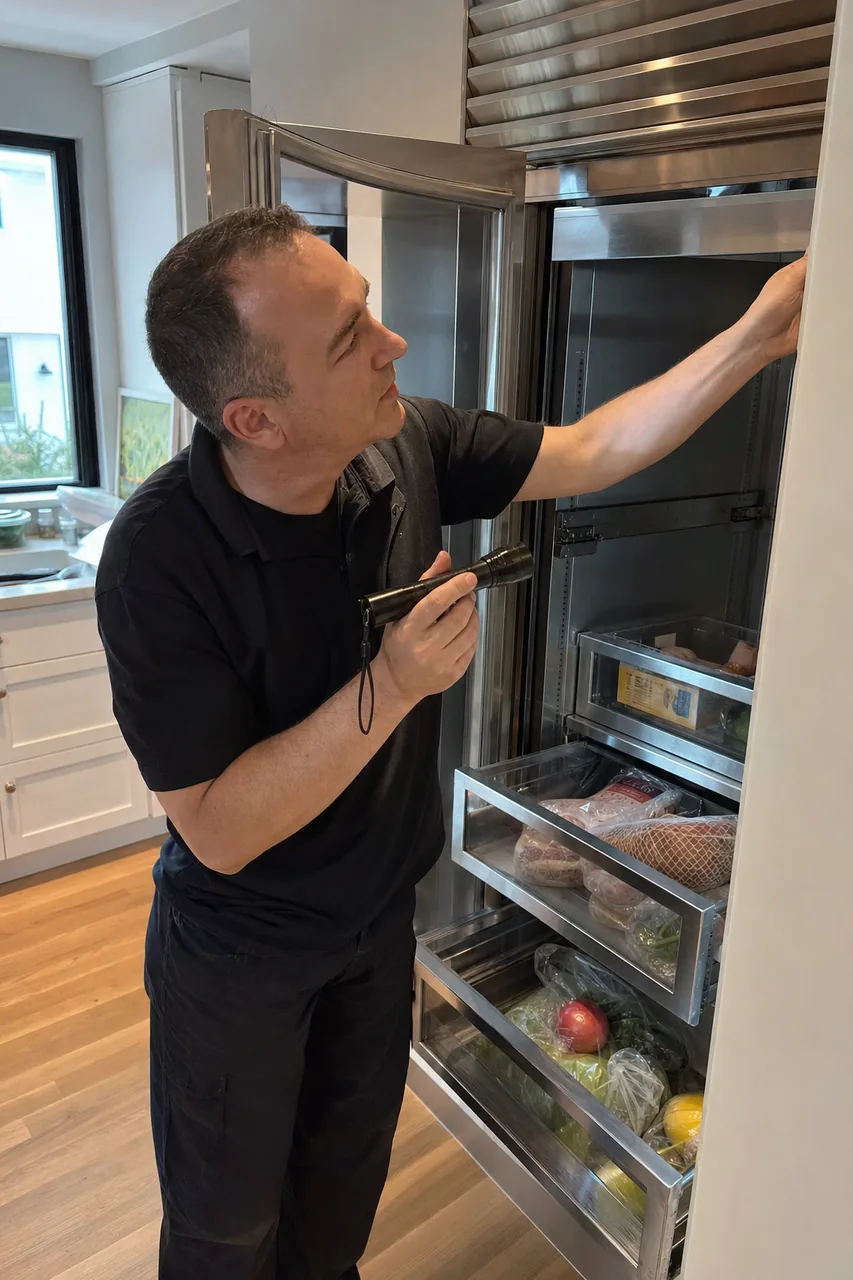
Thermador refrigeration columns drifting warm in Mandarin
Columns and built-ins that drift warm, frost over, run constantly or stop making ice, diagnosed by measurement rather than by parts swapping.
Built-in refrigeration fails in a small number of ways, and the ways look alike from the outside. A cabinet that will not hold temperature can be short of refrigerant, short of airflow, or short of nothing at all except a defrost cycle that has stopped running. All three produce the same complaint at the door, so the first job is to separate them before anything is ordered.
How we tell the three apart
We take temperatures at the evaporator inlet and outlet, watch the condenser fan and the compressor through a full cycle, and read the defrost history the control keeps. A sealed-system fault shows a specific pattern of frost that stops partway across the coil. A blocked airflow fault shows an evaporator that is cold everywhere but a cabinet that is not. A defrost fault shows a unit that works well for days and then slowly loses ground, which is the one homeowners most often describe as intermittent.
Our technicians hold EPA Section 608 certification, so sealed-system work, recovery and recharging are done in-house rather than handed off. That matters mostly to the schedule. It means a confirmed leak does not require a second company and a second appointment.
Airflow is the Mandarin problem
Most of the housing here went up between the 1970s and the 1990s, and the kitchens were laid out before full-height refrigeration columns existed. When a column arrives in one of those kitchens it usually arrives as a retrofit into an opening that was cut for something shallower, with a soffit above it and a run of cabinetry tight to both sides.
Column refrigeration rejects its heat through a grille, and the installation manual asks for a specific clear area in front of that grille and a specific gap behind the cabinet. Retrofits frequently give it less. Nothing fails immediately. What happens instead is that the condenser runs warmer all year and then, through a Jacksonville August with the kitchen at eighty-two degrees, cannot shed heat fast enough to keep up. The unit runs longer, the fresh food side drifts up two or three degrees, and the owner reasonably assumes the compressor is dying.
Before we quote a compressor we check the grille clearance, the condenser itself, and the temperature of the air coming off it. A blocked or dust-packed condenser in a tight opening is common, cheap to correct, and produces exactly the symptoms people expect to be expensive.
Ice makers
Ice production is the complaint most often blamed on the wrong part. An ice maker depends on three things it does not control: a water supply at a sensible pressure, a freezer compartment actually holding its temperature, and a harvest that can release the cubes. Any one of them will produce a bin that never fills.
So the order matters. We check the fill volume first, because a slow fill points upstream at the inlet valve, a restricted line or a filter that has been in place well past its capacity rather than at the ice maker itself. Then the compartment temperature, since a freezer sitting a few degrees above its setting slows every harvest in the day. Only then the module, the mold heater and the ejector.
The timing of the decline is diagnostic on its own. Production that fell away gradually over a year usually points at supply or at deposit on the valve seat and the mold. Production that stopped inside a week, especially alongside a temperature change, is a different fault entirely and no amount of cleaning will touch it.
Doors, gaskets and alarms
A door alarm on a properly shut door is usually a switch or a hinge that has sagged a few millimetres, not a control fault. Gaskets on retrofit installations take more abuse than they should, because a door that clears a face frame by a hair will scuff the same spot on the seal every time it opens. We check the swing and the reveal along with the gasket, since replacing a seal without correcting the clearance simply buys another year.
Every diagnosis costs a flat $80 and is credited toward the repair when you approve the work. You get the findings and a written estimate before any part is ordered.
Symptoms we see on this one
- Fresh food side warms up while the freezer stays cold
- Compressor runs almost continuously and the cabinet never recovers
- Frost building on the back wall or around the evaporator
- Ice maker not making ice at all, or filling but not harvesting
- Ice production has quietly dropped to half a bin
- Water pooling under the crisper or freezing in the drain
- Door alarm sounding with the door properly shut
Call (904) 201-3304
Before the estimate
What does a refrigeration repair cost here?
The visit is a flat $80 and it comes off the repair once you approve it. What the repair itself lands at depends on the part, and these are the bands the work below has actually fallen into. A band is not a quote: the firm figure is written down after the appliance has been opened and measured.
| Repair | Typical range |
|---|---|
| Diagnostic visit | $80 flat, credited |
| Refrigeration column sealed system | $880–$2,300 |
| Control board or touch panel | $430–$1,100 |
Asked on this appliance
What do owners ask about a refrigeration?
- The fresh food side is drifting warm. Does that mean the compressor?
- Not on its own. A cabinet that will not hold temperature can be short of refrigerant, short of airflow, or short of nothing but a defrost cycle that stopped running. All three read the same at the door, so we separate them with temperatures and the defrost history before anything is ordered.
- Why did a column that was fine for years start losing ground in August?
- Because the room changed, not the appliance. A retrofit opening usually gives the grille less clear area than the manual asks for. The condenser runs warmer all year, and through a Jacksonville August with the kitchen in the eighties it can no longer shed heat fast enough.
- What does a compressor or sealed-system repair cost?
- Sealed-system work on a column — the compressor, the condenser and the charge that moves between them — runs $880–$2,300. It is the most expensive repair on the machine, so it is confirmed with temperatures and the defrost history before anyone quotes it rather than after.
- Ice production has halved. Is the ice maker finished?
- Check the order, not the part. An ice maker depends on fill volume, a freezer actually holding its setting, and a harvest that can release. A gradual decline over a year usually points upstream at the inlet valve, the line or a long-overdue filter rather than the module.
After a refrigeration visit in Mandarin
Rated 4.8 out of 5 across 62 customer reviews. Read all 62.
The wine column had gone several degrees warm on the upper shelves only. He found the divider damper stuck part open and freed it, then let the cabinet settle and read both zones again before writing anything up.
Solveig E.April 2026
Frost kept building on one shelf while the rest of the cabinet held. He proved the defrost circuit with the load in place, then found the door had sagged enough to let humid air in at the hinge side. Hinges, not electronics.
Rasheed L.May 2026
Our column drifted into the low fifties while the freezer beside it held fine. He measured the evaporator fan draw, found it stalling as the motor warmed, and changed it. The cabinet was back down before he packed up.
Gideon F.August 2026
The line we work to
Where the work stops
We work on the built-in appliances inside the kitchen and nothing else. The only duct we open is the one above the cooking surface, from the hood to the wall cap outside — the supply and return ducts that heat and cool the house are a different trade altogether and we are not in it. If the call is about a furnace, an air conditioner, an air handler or a vent in the ceiling, we will say so on the phone and send you elsewhere rather than book a visit.
A call from Mandarin about a Thermador appliance is ours. A call from Mandarin about the furnace, the air conditioning or a vent in the ceiling is not, and we would rather tell you that in thirty seconds on (904) 201-3304 than on your doorstep.
We service
- Built-in refrigeration
- Wall ovens and steam ovens
- Ranges and rangetops
- Cooktops and induction
- Ventilation hoods
- Dishwashers
- Warming drawers
- Built-in coffee machines
- Wine columns
We do not service
- Furnaces and central heating
- Air conditioners, air handlers and heat pumps
- Supply and return ducts, ceiling vents and registers
- Thermostats and whole-house humidity control
- Water heaters and house plumbing