Almanac
A Thermador built-in or a freestanding fridge: what you are actually choosing between
Built-in and freestanding refrigerators differ in depth, airflow, storage, typical faults and service. A fair side-by-side for an owner deciding which one belongs in the kitchen.
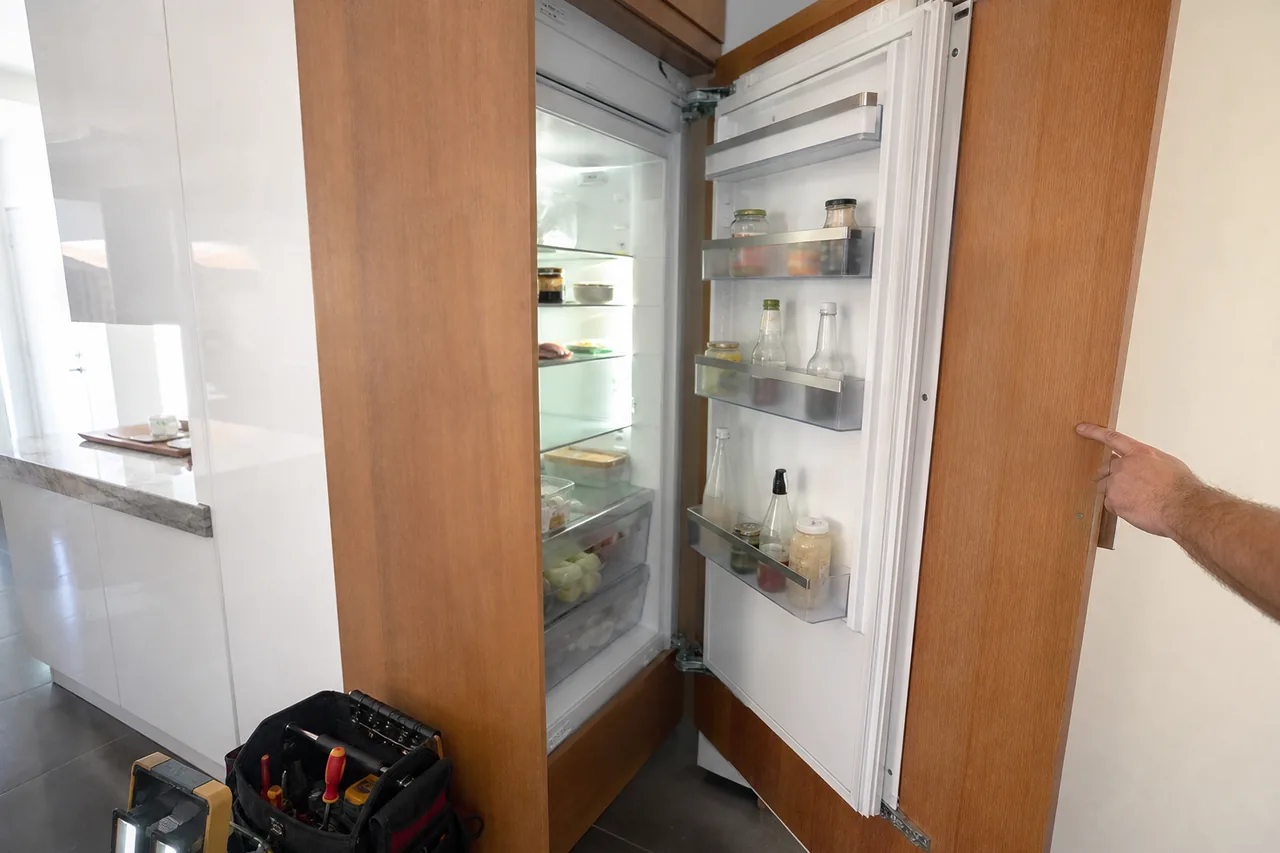
A built-in refrigerator is fixed into the cabinetry, stops at the same depth as the counters, draws and exhausts air through grilles at the front, and is meant to be repaired where it stands for many years. A freestanding refrigerator is a self-contained box: deeper, finished on its sides, cooled through the back and underneath, and simple to roll out and replace. The built-in costs more and needs an exact opening; the freestanding unit gives more storage for the money but less freedom in layout and finish.
How each one is put together
A freestanding fridge carries its own finished sides, handles and trim. It stands on rollers, wants open air around the back and top, and usually juts past the counter fronts. Trading it for a new one takes an afternoon.
A built-in works the other way round. It is anchored to the wall or cabinets, sized to a precise rough opening, and often panel-ready, so its doors wear the same fronts as the kitchen. Thermador’s Freedom Collection shows how far that idea stretches: a freezer column 18 inches wide, refrigerator and freezer columns at 24, 30 and 36 inches, wine columns of 18 inches with two zones or 24 inches with three, and bottom-freezer and under-counter models besides. Each column is its own appliance, so a refrigerator can stand on one wall and its freezer partner elsewhere.
Storage and the way air moves
Depth is the price of that flush look. Because a built-in ends at the cabinet face, it holds less food than a freestanding unit of equal width. As a reference point, the 30-inch Freedom T30IR905SP fresh food column offers 16.8 cu. ft., lets you set the main space anywhere from 36°F to 46°F, and adds a drawer held between 30°F and 38°F for meat and fish.
Airflow is the bigger engineering difference. A freestanding model dumps condenser heat out the back and bottom into the room around it. A built-in is boxed in on three sides, so it pulls cool air in and pushes warm air out through the front, and those openings have to stay clear. Thermador’s column instructions say never to cover them, to vacuum them once each year, and to keep the unit at least 1¼ inches (3 cm) from an electric or gas cooker.
Where each tends to go wrong
Freestanding units mostly fail in ordinary ways: dusty condenser coils, a tired door gasket, a defrost fault, a fan that stops.
Built-ins are fussier about breathing. A grille blocked by a rug or a toe-kick panel, a column fitted tight against a range, or a Mandarin August with the kitchen running warm all make the condenser labor, and the usual first sign is a compartment creeping a few degrees warm by late afternoon.
One built-in quirk surprises new owners. If a Freedom column lights up and its display works but the inside never gets cold, demo mode may be switched on, and in that mode the unit simply sits at room temperature. Turn it off in the Appliance settings menu before booking anyone.
Service, parts and warranty
A freestanding refrigerator rolls forward for service, and when its compressor gives out late in life, plenty of owners simply replace it. A built-in is designed to be repaired in its opening, from the front, with doors and panels left in place.
Parts are matched to the rating label. On a Thermador refrigerator the E-Nr and FD numbers are printed on that label inside the fresh food side, on the right, close to the door; a phone photo of it saves a trip.
Read the warranty before buying either type. Thermador covers its refrigeration under a 2-year limited warranty on the whole appliance, parts and labor. Its built-in refrigerators then add sealed-system coverage for the compressor, evaporator, condenser, dryer/strainer and connecting tubing: with parts and labor covered in the third through sixth years and parts only in the seventh through twelfth, plus lifetime parts-only cover against stainless rust-through. Outside those windows, a sealed-system repair on a column typically lands in the $880–$2,300 range, with the firm figure given in writing after the $80 diagnostic.
Which one suits your kitchen
Freestanding makes sense if you want the most cubic feet for the money, expect to move or remodel soon, or would rather replace than repair. Built-in makes sense if the kitchen is designed around flush cabinetry, you want refrigerator, freezer and wine split into separate columns, and you plan to keep the appliance long enough that repair beats replacement. If you already own one, repair or replace a built-in walks through that call.
Before the estimate
What is this likely to cost?
The visit is a flat $80 and it comes off the repair once you approve it. What the repair itself lands at depends on the part, and these are the bands the work below has actually fallen into. A band is not a quote: the firm figure is written down after the appliance has been opened and measured.
| Repair | Typical range |
|---|---|
| Diagnostic visit | $80 flat, credited |
| Igniter, spark module or surface element | $210–$530 |
| Oven thermostat or temperature sensor | $170–$560 |
| Bake or broil element | $200–$570 |
| Convection fan or motor | $250–$660 |
The line we work to
Where the work stops
We work on the built-in appliances inside the kitchen and nothing else. The only duct we open is the one above the cooking surface, from the hood to the wall cap outside — the supply and return ducts that heat and cool the house are a different trade altogether and we are not in it. If the call is about a furnace, an air conditioner, an air handler or a vent in the ceiling, we will say so on the phone and send you elsewhere rather than book a visit.
A call from Mandarin about a Thermador appliance is ours. A call from Mandarin about the furnace, the air conditioning or a vent in the ceiling is not, and we would rather tell you that in thirty seconds on (904) 201-3304 than on your doorstep.
We service
- Built-in refrigeration
- Wall ovens and steam ovens
- Ranges and rangetops
- Cooktops and induction
- Ventilation hoods
- Dishwashers
- Warming drawers
- Built-in coffee machines
- Wine columns
We do not service
- Furnaces and central heating
- Air conditioners, air handlers and heat pumps
- Supply and return ducts, ceiling vents and registers
- Thermostats and whole-house humidity control
- Water heaters and house plumbing