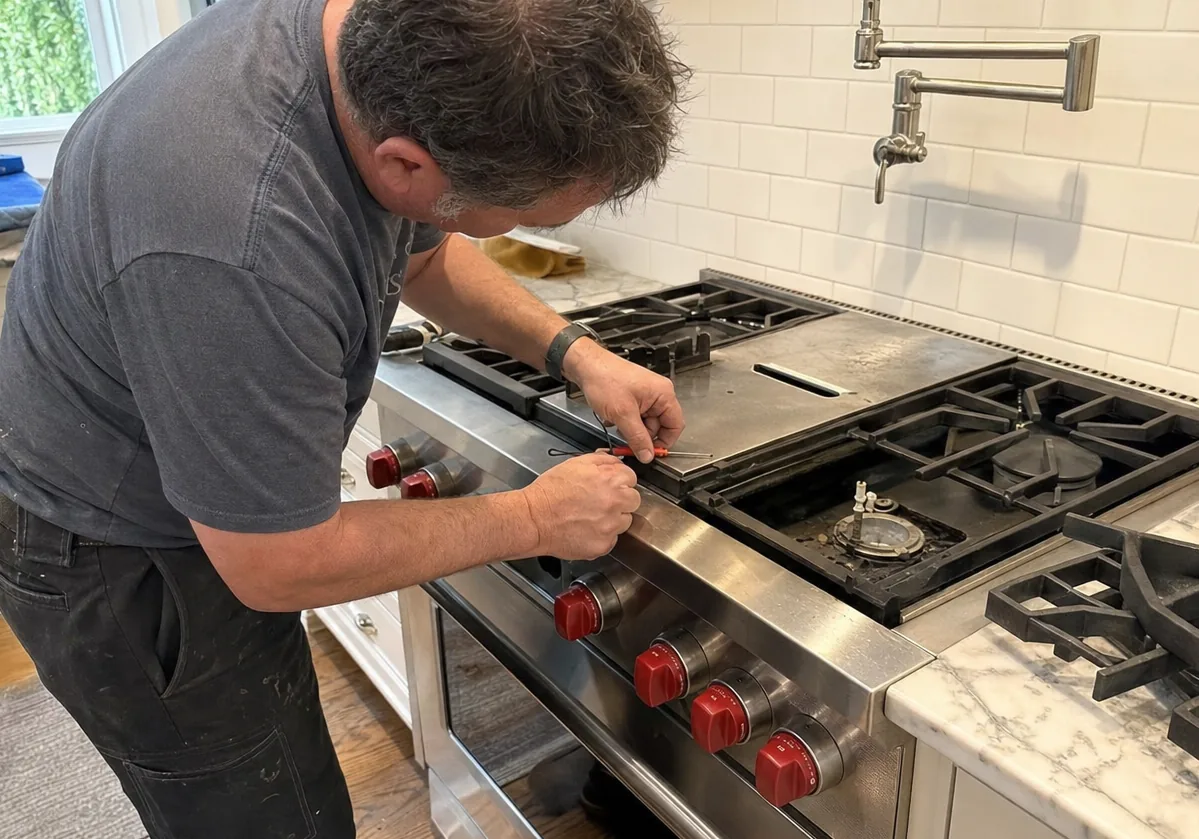
Thermador repair
Thermador hoods that run but no longer clear the air, Mandarin
Hoods that are quiet but no longer pull, blowers that hum without turning, downdrafts that stall halfway, and ductwork that was never right to begin with.
Ventilation is the appliance people call about last and should call about first, because a hood that is not moving air is quietly loading every other appliance in the kitchen with grease and moisture. It is also the appliance where the fault is most often outside the box we were called to look at.
The duct is usually the story
Mandarin’s housing stock is mostly 1970s through 1990s, built on generous lots where kitchens were extended outward rather than rebuilt. That produces long, convoluted duct runs. A hood rated for a short straight run to an exterior wall will move a fraction of its rated air through forty feet of duct with three elbows and a crushed section above a soffit, and the appliance itself will be in perfect health throughout.
The tell is a hood that has always been disappointing rather than one that got worse. Sudden loss of pull points at the appliance or at a blocked filter. Gradual, lifelong underperformance points at the duct, the termination cap, or a run that was reduced from ten inches to six somewhere it cannot be seen.
We check static pressure and look at the termination outside before condemning a blower. Where the duct is the limit we say so and put it in writing, because a new blower on a bad duct is money for nothing.
Blowers
Internal, inline and remote blowers all fail in similar ways. A motor that hums but does not start is usually a capacitor or a seized bearing, and the two are easy to separate by hand. A blower that runs only on the top speed points at the speed control rather than the motor. A blower that has become suddenly loud has almost always shed grease from one side of the wheel, unbalancing it, and cleaning it restores both the noise and the airflow.
Remote blowers mounted in an attic or on an exterior wall run hotter and collect more debris than anyone expects, and they are the ones nobody has looked at since installation. If your hood is quiet at the cooktop but you have never seen the fan, it is probably remote and probably overdue.
Downdraft systems
Downdraft ventilation has moving parts a hood does not, which gives it its own failure list. A downdraft that rises partway and stops is usually the drive belt or the lift motor, occasionally an obstruction in the track, and rarely the control. One that will not retract is the same set of parts read in reverse. Because the mechanism lives in the cabinet below the cooktop, we check for anything stored against the track before assuming a motor.
Make-up air
A professional rangetop with a high-capacity hood over it can pull more air out of a house than the house can replace. In a tightly built home the fan then works against a pressure difference it was not designed for, moves less air, and can pull outside air down a chimney or through a dryer vent.
The symptom homeowners report is a hood that seems weaker with the windows closed. If cracking a window near the kitchen visibly improves the pull, the appliance is fine and the house needs a make-up air path. We will tell you that rather than sell you a blower.
Filters and cleaning
Baffle and mesh filters are the cheapest maintenance in the kitchen and the most neglected. A saturated filter can halve airflow. Wash them properly, on a schedule that matches how you actually cook, and a good number of the calls in this section never need to be made.
The diagnostic is a flat $80, credited toward the repair when you approve the work, with ninety days on labour and three hundred and sixty-five on parts.
Symptoms we see on this one
- Hood runs but no longer clears steam or smoke
- Blower hums and does not start, or starts only on high
- Downdraft rises partway and stops or will not retract
- Controls or lights work but the fan does nothing
- Rattle or roar that appeared suddenly
- Back-draught of outside air when the fan is off
Call (904) 201-3304
Before the estimate
What does a ventilation repair cost here?
The visit is a flat $80 and it comes off the repair once you approve it. What the repair itself lands at depends on the part, and these are the bands the work below has actually fallen into. A band is not a quote: the firm figure is written down after the appliance has been opened and measured.
| Repair | Typical range |
|---|---|
| Diagnostic visit | $80 flat, credited |
| Control board or touch panel | $430–$1,100 |
| Convection fan or motor | $250–$660 |
Asked on this appliance
What do owners ask about a ventilation?
- The hood runs but no longer clears steam. Is the blower failing?
- Look at the duct first. A hood rated for a short straight run to an exterior wall moves a fraction of that air through forty feet with three bends. Something that never performed points at the duct, and no blower we can sell you will fix the duct.
- What does a sudden rattle or roar mean?
- A change that arrived suddenly is the appliance: a dry bearing, a loose wheel, a filter seated wrong, or a damper flapping. Gradual, lifelong underperformance is the duct or the termination cap outside. Which of the two it is decides whether a part is worth buying at all.
- The downdraft rises partway and stops.
- Usually the lift track and the limit switches rather than the motor. A gummed track slows the carriage until a switch never sees its position, and the unit stalls where it stands. Cleaning the track and resetting the switches is the first thing to try, and often the last.
After a ventilation visit in Mandarin
Rated 4.8 out of 5 across 62 customer reviews. Read all 62.
The downdraft stalled halfway up. He found the lift track gummed and a limit switch sitting out of position, cleaned and reset both, and it rises and seats properly now without the grinding noise it had.
Teodor W.June 2026
The blower hummed without turning. He freed the wheel by hand, found the bearing dry and ordered the assembly. It took a few days to land, but the extraction runs quieter now than I remember it ever being.
Guinevere A.July 2026
Only the highest setting would start the blower and even then it laboured. The capacitor had lost most of its value. He measured it in front of me, fitted the replacement and checked the draw on each speed afterwards.
Osgood M.May 2026
The line we work to
Where the work stops
We work on the built-in appliances inside the kitchen and nothing else. The only duct we open is the one above the cooking surface, from the hood to the wall cap outside — the supply and return ducts that heat and cool the house are a different trade altogether and we are not in it. If the call is about a furnace, an air conditioner, an air handler or a vent in the ceiling, we will say so on the phone and send you elsewhere rather than book a visit.
A call from Mandarin about a Thermador appliance is ours. A call from Mandarin about the furnace, the air conditioning or a vent in the ceiling is not, and we would rather tell you that in thirty seconds on (904) 201-3304 than on your doorstep.
We service
- Built-in refrigeration
- Wall ovens and steam ovens
- Ranges and rangetops
- Cooktops and induction
- Ventilation hoods
- Dishwashers
- Warming drawers
- Built-in coffee machines
- Wine columns
We do not service
- Furnaces and central heating
- Air conditioners, air handlers and heat pumps
- Supply and return ducts, ceiling vents and registers
- Thermostats and whole-house humidity control
- Water heaters and house plumbing