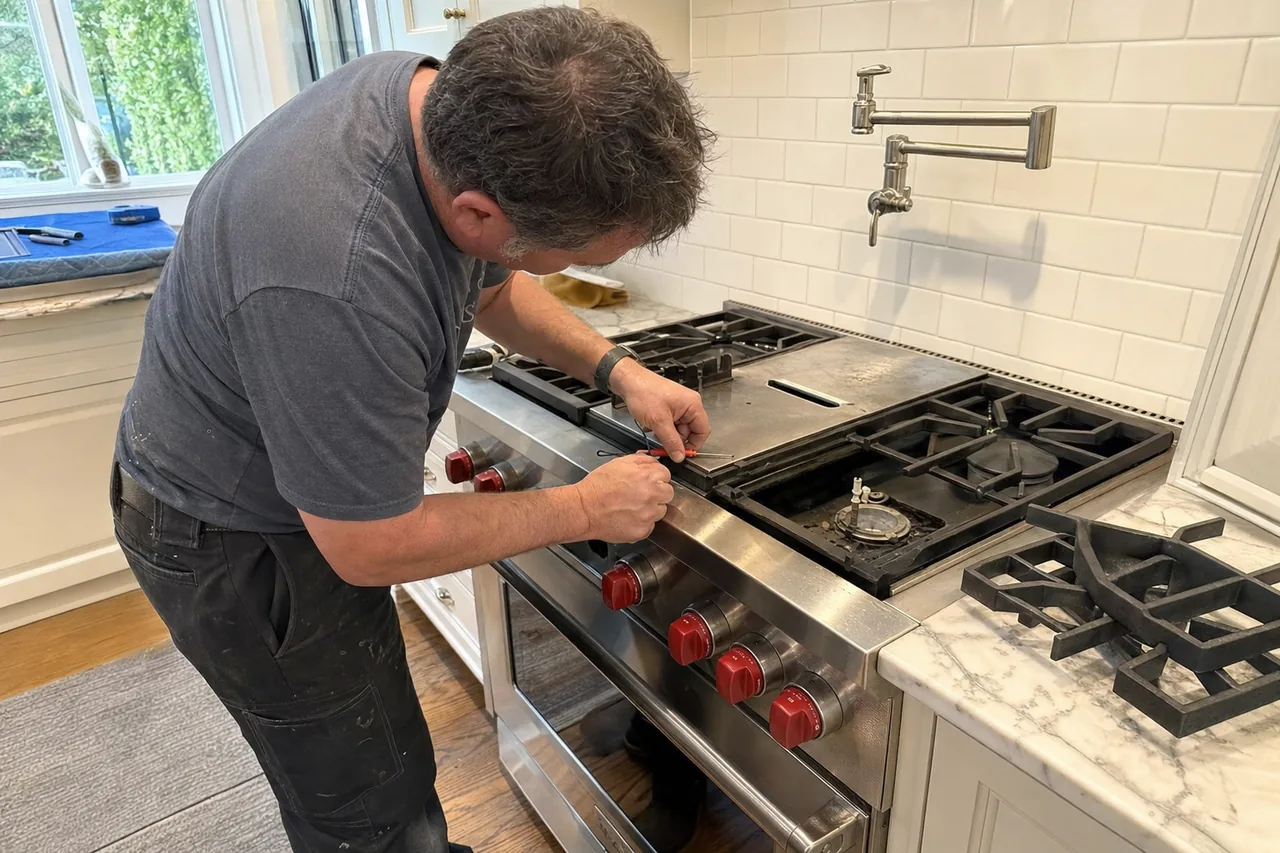
Thermador repair
Thermador range burners that click but will not light, Mandarin
Burners that will not light or will not simmer, ovens that miss their set point, and the gas supply problems that get blamed on the appliance.
A professional range is three appliances sharing a frame. The burner deck, the oven cavity and the control system fail independently, and the useful first question is always which of them is actually at fault, because the answer moves the price by an order of magnitude.
Burners that will not light
Continuous clicking with no flame is usually one of four things, and they are easy to rank. A soaked or misseated burner cap is the most common by a wide margin, particularly after a spill or a thorough cleaning. Next is a fouled igniter electrode, then the spark module driving it, then the gas valve itself.
We test in that order because it is also the order of cost. A range that clicks on every burner at once points at the module, while a range that clicks on one points at that burner’s electrode. If you clean the cap and it lights, you have solved it yourself and you should not pay anyone.
Simmer, flame lift and gas supply
A burner that roars but will not settle to a low steady flame is often not the burner at all. Professional ranges ask a lot of the gas supply, and a house that added a range, a rangetop or a pool heater since the meter was sized can run short at the far end of the line. Flame lift and a simmer that goes out when another appliance fires are both supply symptoms.
We measure static and working pressure at the appliance before we touch a valve, because replacing an orifice on a range that is being starved will not fix anything. If the fault is upstream we say so plainly and put it in writing rather than selling a part.
Ranges also leave the assembly line set for natural gas or propane, and a conversion done without changing every orifice and the regulator setting produces exactly the flame behaviour described above. It is worth mentioning if the appliance moved house with you.
The oven half
Oven complaints on a range are diagnosed the same way we approach a wall oven. An independent probe goes on the centre rack and we watch a full heat cycle rather than trusting the display, which separates a sensor reading high, a bake element that has lost part of its length, and a control that is calling for heat correctly but not getting it. On a double range we run both cavities, because a shared control with one dead output looks very different from two independent faults.
Convection is worth checking separately. A convection motor that has stiffened still turns, just slowly, and slow airflow produces uneven browning that reads like a temperature problem.
Storms
Mandarin sits in a part of Florida that sees roughly sixty-eight thunderstorm days a year. Surges rarely kill a range outright. They usually take one function first, most often the display, the clock or the convection circuit, while everything else keeps working normally. If the behaviour changed on a stormy afternoon, tell us when you call. It narrows the diagnosis considerably and it sometimes changes whether a homeowner’s insurer is interested.
Older Mandarin installations
Kitchens here were largely built between the 1970s and the 1990s, on lots generous enough that the kitchen was extended later rather than rebuilt. A professional range dropped into that kind of kitchen frequently sits in an opening cut to fit, with less side clearance to combustible cabinetry than the manual asks for and, on dual-fuel installations, a circuit shared with something else.
We check the opening and the supply as part of the diagnostic, not as an upsell, because a range that keeps cooking its own control board is telling you about the cabinet, not the appliance.
The visit and the diagnosis are a flat $80, credited toward the repair when you approve the work, and you get a written estimate before any part is ordered.
Symptoms we see on this one
- Burner clicks repeatedly but will not light
- Igniter keeps clicking after the burner has already lit
- Flame lifts off the burner or will not hold a low simmer
- Oven takes far longer to preheat than it used to
- One oven in a double range works and the other does not
- Griddle or grill section heats unevenly across its surface
- Range is dead with no display after a storm
Call (904) 201-3304
Before the estimate
What does a range repair cost here?
The visit is a flat $80 and it comes off the repair once you approve it. What the repair itself lands at depends on the part, and these are the bands the work below has actually fallen into. A band is not a quote: the firm figure is written down after the appliance has been opened and measured.
| Repair | Typical range |
|---|---|
| Diagnostic visit | $80 flat, credited |
| Oven thermostat or temperature sensor | $170–$560 |
| Igniter, spark module or surface element | $210–$530 |
| Bake or broil element | $200–$570 |
| Control board or touch panel | $430–$1,100 |
Asked on this appliance
What do owners ask about a range?
- One burner clicks and will not light. What is wrong?
- Four things, ranked by cost. A soaked or misseated burner cap is the most common by a wide margin, then a fouled electrode, then the spark module, then the valve. Clicking on every burner at once points at the module; clicking on one points at that burner.
- Why will the burner not hold a low simmer?
- Frequently the gas supply rather than the burner. A professional range asks a lot of the line, and a house that has added appliances since the meter was sized can run short at the far end. We measure static and working pressure at the appliance before touching an orifice.
- The igniter keeps clicking after the burner has lit. What does that cost?
- Most often a soaked or misseated burner cap, which costs nothing to put right and you can do it yourself. Where the electrode or the spark module driving it is genuinely at fault, that work sits at $210–$530 in the table on this page, and the visit decides which of the two you have.
- The range lost its display after a storm. Is the whole thing dead?
- Rarely. A surge normally takes one function first, most often the display, the clock or the convection circuit, and leaves the rest working. Tell us the afternoon it changed when you call: the timing narrows the diagnosis and sometimes decides whether an insurer is interested.
After a range visit in Mandarin
Rated 4.8 out of 5 across 62 customer reviews. Read all 62.
The griddle plate was scorching at the back and barely warm at the front. He checked both burner tubes underneath and found one partly blocked with carbon. Cleaned it out and the surface reads even across now.
Ravi M.June 2026
The igniter work was done properly and the burner lights first time now. What I did not like was being told on the phone that the part was a common one, then waiting for a second visit because our serial takes another.
Leopold V.July 2026
Preheat had crept from fifteen minutes to well over half an hour. The bake element was intact but the door seal had flattened along the hinge side and heat was pouring out. New seal, and preheat is quick again.
Imani C.July 2026
The line we work to
Where the work stops
We work on the built-in appliances inside the kitchen and nothing else. The only duct we open is the one above the cooking surface, from the hood to the wall cap outside — the supply and return ducts that heat and cool the house are a different trade altogether and we are not in it. If the call is about a furnace, an air conditioner, an air handler or a vent in the ceiling, we will say so on the phone and send you elsewhere rather than book a visit.
A call from Mandarin about a Thermador appliance is ours. A call from Mandarin about the furnace, the air conditioning or a vent in the ceiling is not, and we would rather tell you that in thirty seconds on (904) 201-3304 than on your doorstep.
We service
- Built-in refrigeration
- Wall ovens and steam ovens
- Ranges and rangetops
- Cooktops and induction
- Ventilation hoods
- Dishwashers
- Warming drawers
- Built-in coffee machines
- Wine columns
We do not service
- Furnaces and central heating
- Air conditioners, air handlers and heat pumps
- Supply and return ducts, ceiling vents and registers
- Thermostats and whole-house humidity control
- Water heaters and house plumbing